Common Misconceptions
in AI Transformation
for Engineering Teams
What is the logical starting point of AI-native engineering?
The hard questions are rarely about which AI tool is better
What can AI actually do, and where does it break?
Capability boundaries, responsibility boundaries, trust boundaries.
Why do concepts travel faster than adoption?
Prompts, agents, MCP, workflows: useful words, incomplete answers.
How do we judge real AI competence?
Tool usage is visible. System design is harder to see.
Why does individual productivity not become org productivity?
Local speed hits coordination, review, context, and ownership.
Why does productivity not automatically become business value?
More code does not create more valuable problems.
Will "software engineering" look the same three years from now?
The center of gravity moves from writing code to directing systems.
engineering, organization, and business need to be reinterpreted together.
To understand AI transformation, we need to ask three layers of questions
What changed at the interface layer?
Natural language became a new way to direct computation.
What changed in the cost structure?
Acceleration, democratization, and repricing.
What remains scarce?
New value does not come from faster execution alone.
Many AI programs stall because the problem is framed too narrowly
AI is a paradigm shift. Paradigm shifts require unlearning.
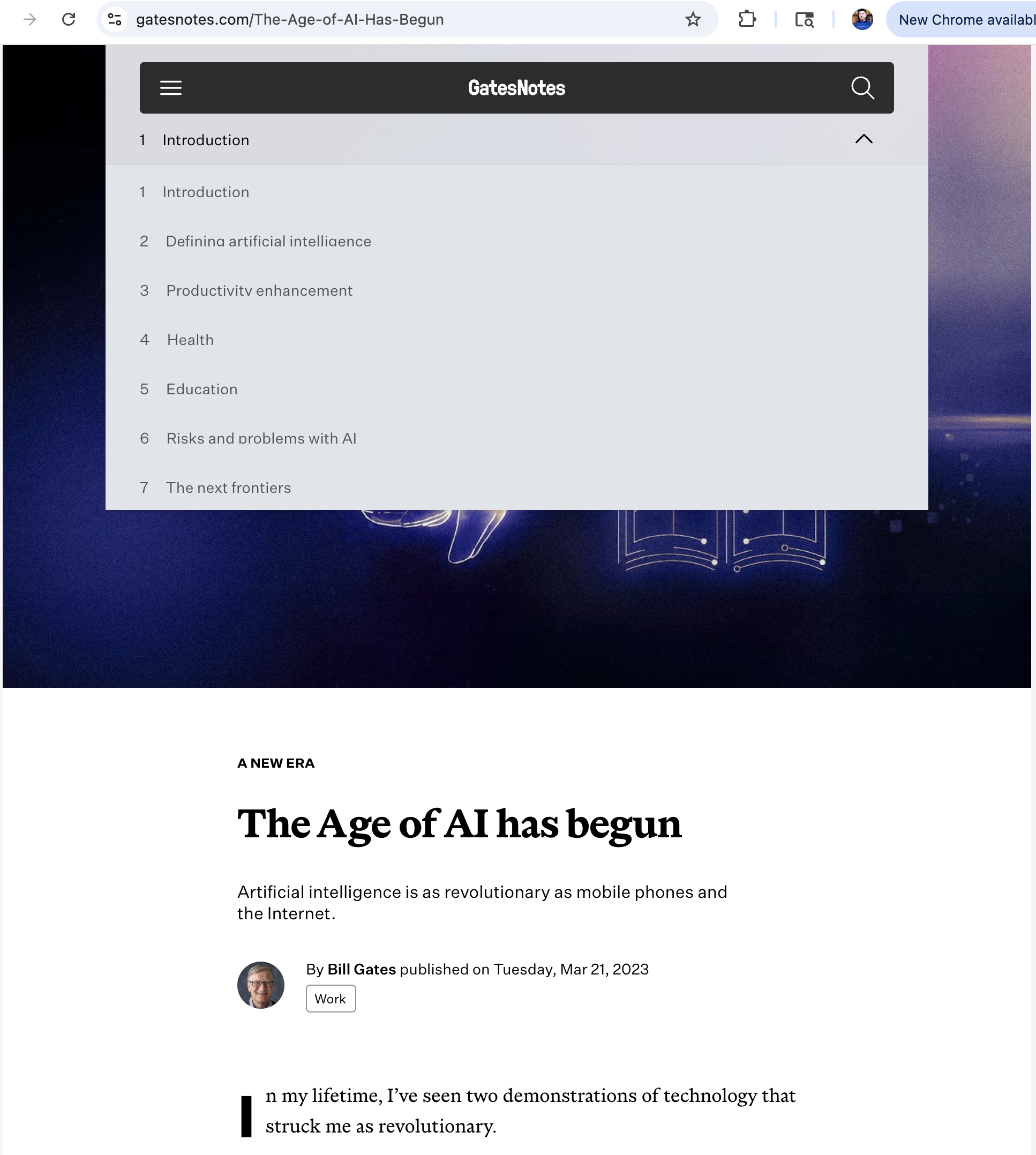
The second was AI. What was the first?
And why did that one matter?
AI is the third major interface for directing computation
Command line
Humans express intent in machine-friendly commands.
Graphical interface
Humans direct software through fixed buttons, menus, and flows.
Intent interface
Humans describe goals, context, and constraints. AI routes the work through tools, code, and files.
The real change is at the interface layer between human intent and computational execution.
Natural language interfaces make User Generated Software economically plausible
Predict common needs, ship fixed products
- Demand has to be productized
- Workflows have to be standardized
- Long-tail use cases are often uneconomic
Generate capability around a specific task
- Scripts, pages, analyses, and tools can be made on demand
- Software becomes closer to the task itself
- The long tail becomes newly addressable
In the AI era, building for others gets harder
it raises the bar for getting a feature adopted.
Intent becomes function
The context, assumptions, failure modes, and fixes all live in the author's head.
Function becomes trust
Other people need to understand, adopt, verify, depend on, and escalate it.
Generation gets cheap. Adoption gets expensive.
Context, trust, responsibility, integration, and maintenance become scarcer.
When "making it" is no longer scarce, what others adopt is a lower-cost trust relationship.
From product to Generative Kernel
AI-native software ships a kernel for generating products.
Core capabilities
APIs, data, models, protocols, and business assets that are hard to replicate.
AI-readable knowledge
Rules, patterns, failure modes, examples, best practices, and retrieval entry points.
Deterministic assists
Tools that turn repetitive, error-prone generation steps into reliable operations.
The metrics change: expressive range, intent fidelity, and generation efficiency.
AI changes three things in engineering: acceleration, democratization, and repricing
Building gets faster
Code, docs, prototypes, tests, migrations, and small fixes move faster.
Skill boundaries blur
Coding, design, slides, writing, and analysis become more generally accessible.
Engineering value shifts
When code gets cheap, problem definition, context, verification, maintenance, and responsibility get expensive.
When code gets cheap, the expensive parts of engineering move elsewhere
AI Native changes the cost assumptions behind engineering principles
AI Native starts from the nature of the task, then redesigns the way work gets done
Start with the work: what is it trying to accomplish?
What must this task accomplish?
Clarify friction, quality, risk, and acceptance.
Which constraints changed?
Generation, search, execution, validation, and experimentation costs.
How should the workflow be redesigned?
Reallocate work across people, AI, code, tools, data, and evaluation.
Move from nouns to verbs, then from verbs to outcomes
prompt / agent / MCP
Nouns change quickly and can become labels for adoption theater.
retrieve, judge, generate, verify
Verbs map to real workflow steps.
reduce friction, improve quality, control risk
A verb has value only when it serves an outcome.
What is this work actually for?
Then decide whether an agent, workflow, MCP, or ordinary tool is appropriate.
A concept that does not change the verb, the outcome, or the nature of the task is still just a label.
The gap between AI Users and AI Builders is a set of method-level gaps
When individuals get faster, the operating model has to change
organization-level speed depends on whether the structure changes with it.
Incentive mismatch
If people are evaluated by time and process, saved time rarely becomes organization-level output.
Coordination drag
Meetings, approvals, and alignment rituals were designed for an era when execution was expensive.
End-to-end accountable pods
Small teams own product outcomes and assemble traits rather than rigid job-family lanes.
Data shows the same gap: AI is widely used and developers often feel faster, yet organization-level outcomes depend on workflow, context, validation, and incentive design.
When team AI performance is inconsistent, the problem is often context
when the context quality changes.
Map where context lives
Docs, meetings, chat, code, project systems, and human memory.
Design flow and loading
Working memory, project memory, organization memory, and progressive disclosure.
Make it operational
Git, knowledge bases, MCP, AGENTS.md, MEMORY.md, and portable team assets.
Team compounding happens when senior judgment becomes readable, executable, and updatable by AI.
Why does higher productivity not automatically become more revenue?
they get paid for market-valued outcomes.
Code is supply-side capability
AI makes supply cheaper and faster.
Demand is still constrained
Valuable problems do not appear just because implementation gets cheaper.
Business is a matching problem
The hard part is finding needs worth solving, distributing, and charging for.
When future opportunities are unclear, adapt to the new productivity first
Wait until the business model is obvious
It sounds prudent, but it delays the development of judgment and taste.
Build fluency, then explore faster
Many opportunities become visible only after you know how the new capability feels in real work.
As Steve Jobs put it at Stanford, dots are much easier to connect in hindsight than in advance.
Great opportunities are often discovered, not planned
The reminder from Why Greatness Cannot Be Planned
In open-ended innovation, optimizing directly for a distant objective can mislead. Progress often comes through stepping stones, novelty, and exploration.
Applied to AI transformation
- Try new ways of completing real work
- Use feedback to refine opportunity judgment
- Use cheap experimentation to discover hidden demand
- Turn exploration into organizational assets
Engineering organizations need bounded exploration systems
The opening questions can now be answered through one coordinate system
To solve technical problems, we need to understand what sits above technology
Technical problems
Require understanding the cost structure behind the technology.
Individual performance
Moves from execution speed to goals, context, evaluation, and responsibility.
Organizational performance
Depends on the relationship among engineering, workflow, incentives, and business outcomes.
The real method is a transferable structure for judgment
technology belongs inside business, code belongs inside outcomes, and productivity belongs inside organization design.
it builds a stable coordinate system for decisions.
This framework comes from teaching, enterprise training, and field cases
Superlinear Academy / AI Builders
Training real builders across AI usage, AI coding, AI architecture, and context engineering.
Enterprise training observations
The recurring bottlenecks are goals, context, evaluation, governance, and business connection.